
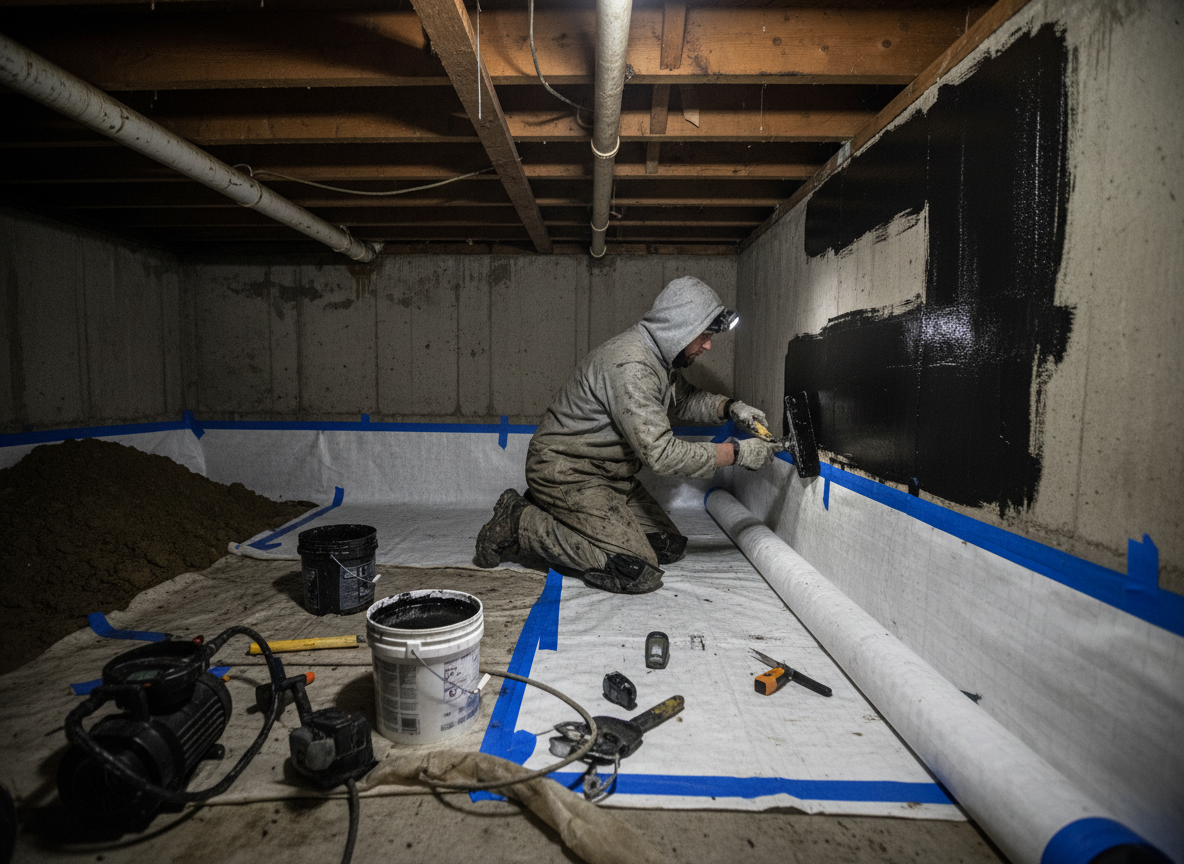
A crawl space is the part of the house most exposed to the ground, and in Vancouver's cool, wet winters it often shows the first signs of a moisture problem. Roughly 42 inches of rain fall in an average year, mostly from late fall through winter. If water is not carried away from the house, it can collect under the floor, and bare or poorly covered soil releases humidity into the space all year. Over time, that moisture can lead to mold, damp insulation, rot in framing and a musty smell throughout the house.
Where crawl space moisture comes from
- Standing water or wet soil after rain, from poor drainage outside or groundwater
- Water entering through foundation walls or vents
- Humidity rising from bare soil that has no effective ground cover
- Condensation: in a vented crawl space, warm, humid air can enter through the vents and condense on cold framing, which over time can cause rot and mold
- Plumbing leaks that need to be ruled out
What a dry crawl space looks like
Building-science guidance is consistent on the basics. Heavy polyethylene should cover the ground, sealed to the walls and piers, whether the crawl space is vented or not. Where water collects, the ground should drain toward a sump or drain so it does not pool beneath the liner. A liner on its own does not help if water is also entering through the wall. Outside, gutters, downspouts and grading should move roof and surface water away from the foundation.
Vented or sealed?
Whether to vent a crawl space is debated in the Pacific Northwest. Traditional venting can work in a climate with less humid summers than the Southeast, but Washington State University points out that warm, humid air entering through vents can condense on cold framing. A sealed, conditioned crawl space controls moisture more directly. The best choice depends on the house, the water situation and local building rules, which we check for your home.
Signs your crawl space needs attention
- A musty smell in the house, especially in wet weather
- Standing water, wet soil or damp insulation under the floor
- Mold or mildew on joists, subfloor or stored items
- Floors that feel cold, soft, damp or sagging
- Insulation that is wet, sagging or falling down
- Condensation on ducts or pipes in the crawl space
Related services, guides and areas
- Often combined with: exterior drainage systems, sump pump installation and foundation waterproofing
- Guides: how to check crawl space humidity levels and signs of moisture problems after heavy rain
- Where we work: Hazel Dell, Orchards, Felida, Uptown Village and Downtown Vancouver
Have a damp or musty crawl space? Contact us and describe what you see.
Crawl Space Waterproofing Services We Offer
✓Ground Cover (Vapor Barrier) Installation
Heavy polyethylene over the soil, sealed to the walls and piers, to stop ground moisture rising into the space.
✓Crawl Space Drainage and Sump
Drainage that collects water and carries it to a sump pump, so it does not pool under the liner.
✓Crawl Space Encapsulation
A sealed ground cover and wall treatment, often with a dehumidifier, that turns the crawl space into a controlled, conditioned space.
✓Insulation and Air Sealing
Replacing wet or failed insulation and sealing air leaks, matched to whether the space is vented or sealed.
✓Exterior Drainage Corrections
Gutters, downspout extensions and grading that move roof and surface water away from the foundation.
Crawl Space Waterproofing Cost in Vancouver, WA
| Service | Typical Range | What Affects It |
|---|---|---|
| Ground cover (vapor barrier) | Call for an estimate | Depends on crawl space area, access and the number of piers and walls to seal. |
| Drainage and sump pump | Call for an estimate | Depends on where water collects and on the discharge route. |
| Full encapsulation | Call for an estimate | Depends on size, wall treatment, insulation and dehumidification. |
| Insulation and air sealing | Call for an estimate | Depends on the condition of existing insulation and the area involved. |
Ranges are typical for Vancouver, WA and confirmed with an exact written quote before any work starts.
How it works
- 1
Inspection
We look at the crawl space, the foundation, the outside grade and gutters, and any sign of water, damp or rot.
- 2
Finding the source
We work out whether the moisture is standing water, wall seepage, humidity from the soil or condensation, because each needs a different fix.
- 3
Explaining the options
We explain the findings and the options, such as drainage, a sealed ground cover, encapsulation or outside corrections.
- 4
Installation and cleanup
We carry out the agreed work, test drains and pumps where installed, and clean up the area.
Pricing
Cost depends on the size of the crawl space, access, how much water is involved and whether drainage, a sump or encapsulation is needed. We give an estimate once we have seen the space.